

Appreciation Event for the Film “Habibi” Hosted by the Tamil Film Producers’ Guild!
“Habibi” – A Film Capturing the Lives of Tamil Muslims; Appreciation Event Held for the Cast and Crew!
Directed by Meera Kathiravan, “Habibi” is a romantic family drama centered on the lifestyle of the Tamil Muslim community. Jointly produced by Romeo Pictures, Nesam Entertainment Pvt. Ltd., and GKS Brothers Productions, the film features a cast that includes Kasthuri Raja, Eesa, Malavika Manoj, Dhanashree Sudhakaran, Anusreya Rajan, and Arulkumar. Sam C.S. composed the music, while Mahesh Muthuswami handled the cinematography.
Chronicling a family’s journey from the 1980s to the present day, the film captures the culture, beliefs, family ties, romance, and aspirations of the Muslim community in Southern Tamil Nadu, as well as the life changes unfolding against the backdrop of the handloom weaving industry. “Habibi” has garnered attention in Tamil cinema for its detailed and intimate portrayal of the everyday lives of Tamil Muslims. Since its release, the film has received acclaim for its storyline, cultural depictions, and the natural portrayal of its characters.
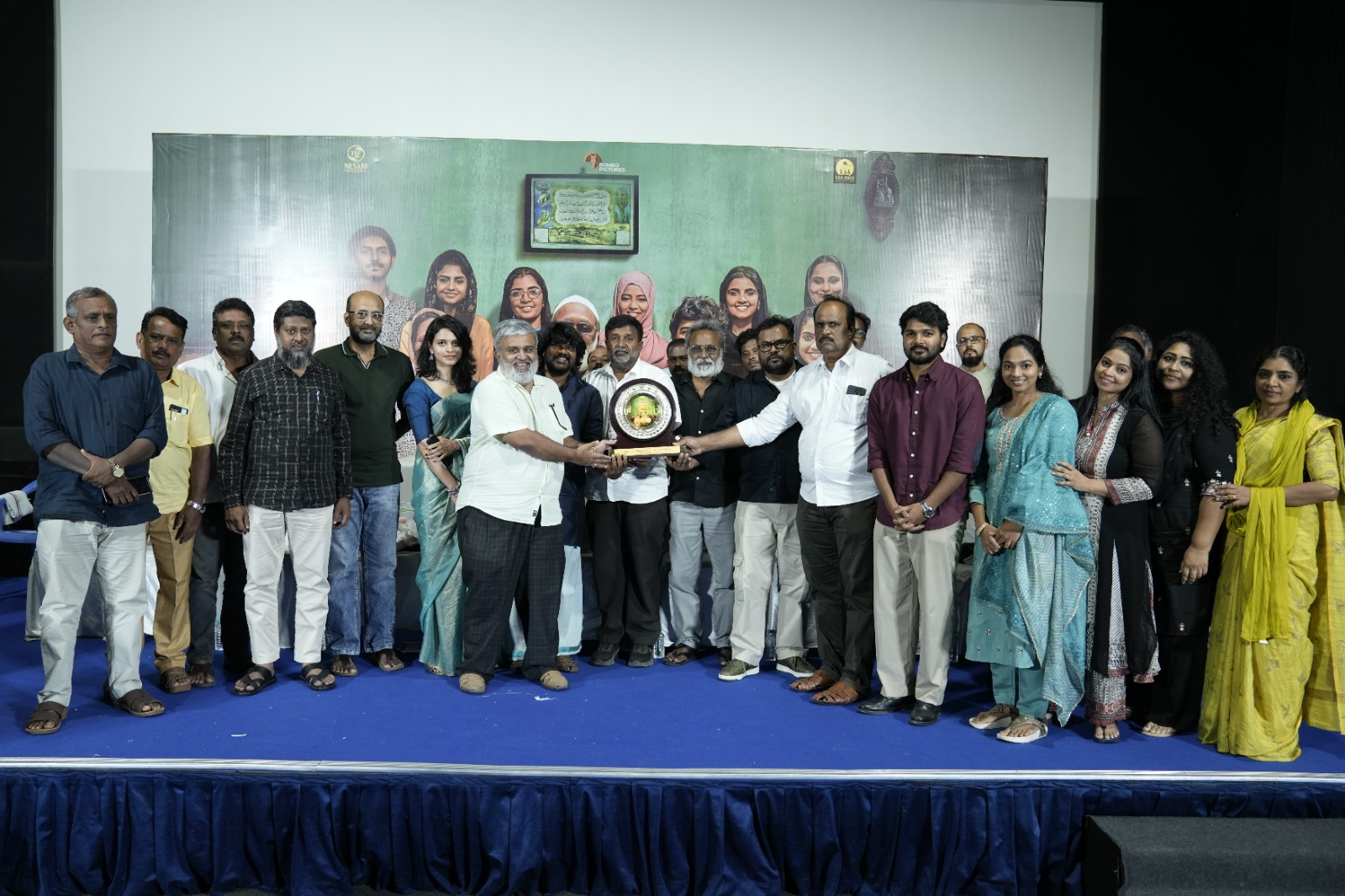
Following its theatrical release and subsequent debut on the SonyLIV OTT platform, an event was held in Chennai to honor the film’s cast and crew, celebrating the positive reception it continues to receive as it marks its 125th day. Organized by the Tamil Film Producers’ Guild, the event also featured a special screening of the movie. Prominent figures from the film industry attended as special guests to appreciate the team behind the film. Speaking at the event on behalf of the Producers’ Guild, Chakravarthy said:
“‘Habibi’ is a work akin to an epic. I extend my heartfelt gratitude to the director and the film crew for creating such a movie. It is a matter of pride for me to host an appreciation event for this film. Works like this deserve greater recognition.
I have many Muslim friends. When I was in the tenth grade, I had a friend named Harshad; I also have a friend named Sameer here in Chennai. Our bond was never based on religion; it was rooted in love and friendship. I wonder where that love and affection have gone now.
Moving beyond the misconceptions often associated with Muslims, this film poignantly portrays their true way of life, their love, and their humanity. It conveys the message that we must all transcend religious differences and live together united as brothers and as Tamils.
It is true that I felt some disappointment at not receiving the level of recognition I had hoped for through the films I produced and acted in. Nevertheless, this platform—dedicated to appreciating a work like ‘Habibi’—brings honor to both me and the Producers’ Guild. My best wishes to the entire film crew. Thank you, Vanakkam, and Jai Hind!” Journalist and director Kodangi spoke as follows:
“This is not a lavish event, but a wonderful and beautiful one. What matters most is how highly we value and champion works like ‘Habibi’. Through this film, director Meera Kathiravan conveys the message of love. Love knows no religion, caste, or language; yet, for such love to triumph, it often requires immense struggle. I am watching this film for the second time, and in every scene, one can sense the director’s vision and hard work.
“Only the producers, directors, and actors truly know the struggle involved in creating a fine piece of cinema. I, too, have worked as a journalist for 30 years and have both produced and directed films. I understand the pain a producer feels if a film stalls midway, as well as the anguish a director endures in trying to bring a good work to the audience. The way Kasthuri Raja has internalized and portrayed his character in this film is highly commendable; he grasped the director’s vision and truly transformed into that character.
“Hundreds of low-budget films are released in Tamil cinema every year. Many producers fade into obscurity, while many directors and actors fail to find opportunities. In such a climate, we must appreciate the creators of quality work while they are still active. Only when good films receive due recognition will creators feel the enthusiasm to continue making such movies. While commercial success is important, we must also celebrate emotionally resonant and beautiful works.
“Why should a film be viewed differently simply because it tells a story about Muslims? Many films are made centering on Hinduism or Christianity; films that depict the lives of Muslims deserve the same level of attention and support.” The film industry should celebrate films like ‘Habibi’ in a big way. The director who worked on this film…
…I extend my heartfelt appreciation and best wishes to the producer, the cast, and the entire technical crew,” he said.
Producer Kovai Ibrahim spoke as follows:
“Greetings to everyone. My good evening to the Habibi film crew present at this event, Director Meera Kathiravan, Mr. Kasthuri Raja, and all others here. I offer my sincere thanks and best wishes to the members of the Guild who have come forward to celebrate and appreciate our film.
“I do not wish to speak at length. Since many distinguished guests are here to speak, I will keep my remarks brief. We are capable of delivering quality cinema—not just in the form of small films, but big-budget ones as well. Appreciation events like this are essential for producers like us to continue making films; such recognition gives us a great boost of enthusiasm. We look forward to meeting you soon with the announcement of our next film. The film’s director and crew will speak about the other details in depth. Thank you.” Producer Sahul Hameed spoke as follows:
“On behalf of Nesam Entertainment Private Limited, we have previously celebrated over ten outstanding films. That list includes movies such as To Let, Pariyerum Perumal, and Kottukkaali. The objective behind organizing such events is to bring quality cinema to the public. Today, Tamil cinema is facing a challenging environment. Malayalam cinema serves as an excellent example for us; even those who do not speak the language watch these films on OTT platforms, grasping and embracing the themes they convey. It stands as proof that even low-budget films can take profound ideas to a global audience.
“Our debut film won numerous international awards and even earned us an invitation to the Cannes Film Festival. That experience opened up a new world for me. However, Habibi is no ordinary creation; it is the long-cherished dream of director Meera Kathiravan. He has worked tirelessly on this film for nearly five years. Having journeyed alongside him, I witnessed firsthand the immense effort he poured into making this project—his dedication was so intense that one would often wonder when he ever found time to rest. It is thanks to such commitment that we are able to celebrate this magnificent work today. The fact that this film has been screened in various parts of the world is no small feat. The contributions of production houses like Romeo Pictures and GKS Brothers have also been vital to this journey. I consider the Guild’s celebration of this film to be one of the most wonderful moments of my life.” “Securing theater screenings is a massive challenge for low-budget films in Tamil cinema. Our movie ran for four weeks, yet it still had the potential to reach many more locations. We received requests to screen the film in areas like Aruppukottai and Ramanathapuram, but because big-budget films were released in the subsequent weeks, we were unable to take our movie to those regions. Often, just as a film succeeds in major theaters and prepares to move to other centers, the release of new big-budget movies diminishes the opportunities for smaller films. Film industry associations bear the responsibility of finding a solution to this issue. Ensuring that low-budget films receive adequate theater space and release opportunities must be a priority. I leave you with the question: will a solution be found for this problem? My heartfelt thanks to everyone who made this opportunity to celebrate the film ‘Habibi’ possible. Thank you,” he said.
Actor Kasthuri Raja spoke as follows:
“We have participated in nearly 40 or 50 events for the film ‘Habibi.’ We traveled to many places by car, train, and flight, experiencing both joy and hardship. We continue to receive praise to this day; many people compliment my performance in the film. It was Director Meera Kathiravan who nurtured us—much like a mother feeding her child—and guided us through it all. I know very well that nothing can be achieved in a film without a director’s vision and guidance. I have been in the film industry for nearly 48 years and have directed 25 films. Speaking from that experience, I can say that the director’s contribution is crucial to every aspect of a film.
“The experience of acting in this film was truly delightful for me. There was no disparity shown toward anyone during the shoot; We were all treated simply as ordinary human beings. It is true that I did have an ego regarding one thing: I had spent so many years in cinema, rising from assistant director to director and producer, and had introduced many innovative initiatives. I had also taken good care of my family.
Just when I thought I could finally relax, Meera Kathiravan came to my home and asked me to act in a film. To be honest, I had no interest in acting. I cannot act—neither on screen nor in real life; I simply speak my mind exactly as I feel it. I even told him, “I don’t know how to act; if you cast me, you’ll end up regretting it.”
“But he persisted. I consulted my family as well. It was only two or three days later that I picked up the screenplay he had given me and read it. As I read on, I realized how much effort the director had poured into the story. I felt there was something truly special about it. Although I didn’t have a complete understanding of the Muslim way of life or its tenets, I hesitantly agreed to give it a try. I never expected the decision to lead to such a wonderful experience. To this day, there hasn’t been a single moment of friction between us. I cannot imagine this film being directed by anyone other than Meera Kathiravan; I have witnessed firsthand how he treats everyone equally. This film has restored the name and identity of ‘Kasthuri Raja’ to me. Before this, most people used to call me ‘Yusuf Bhai.’ Now, hearing people call me ‘Kasthuri Raja Sir’ again brings me joy.
“I am a devout Hindu—through and through. Yet, the director never pressured me to change who I am just because I was acting in this film. This movie taught me that if the story and character are clearly understood, the necessary emotions emerge naturally. My thanks go to the producers, artists, and technical crew who worked on this film. In the current climate, it takes immense courage to make a movie.” “Everyone should come forward to continue making films like this and to invite me to act in them again and again. I extend my heartfelt gratitude to everyone—including Director Meera Kathiravan—who contributed to the success and acclaim of this film.”
Director Meera Kathiravan spoke as follows:
“More than 50 events have been held so far to appreciate the film Habibi, and it continues to receive praise from various quarters. Director Ram had remarked that I would likely be receiving accolades for at least three months after the film’s release. I do not know what auspicious moment he chose for that prediction, but to this day, appreciation for the film continues to pour in from all over the world. The reason for this is the love shown by all of you. Previously, writers, women’s groups, Islamic organizations, and groups that transcend caste and religious lines have praised the film. Now, having producers come together to appreciate it marks a truly special moment for me. Without producers, my story would have remained merely on paper. I view the collective appreciation of Habibi by the members of the South Indian Film Producers Council as a significant event in Tamil cinema.” “After my first film, circumstances arose that allowed me to produce my second film myself. However, it was only after producing a film that I fully grasped the importance of a producer. The encouragement and recognition provided by producers instill the confidence to keep creating good films. All the actors, including Kasthuri Raja sir who acted in Habibi, extended tremendous cooperation. This film served as a significant opportunity for many, including Dhanasree and Malavika Manoj. Actors such as Vijayakumar, Jayashree, Malar, Rizwana, and Mashook, as well as technicians like Udhay and Mathi, have made excellent contributions. I extend my gratitude to everyone who worked on this film, including the assistant directors.
“Tamil cinema boasts a 110-year history. Every region of Tamil Nadu possesses a unique language and way of life. Stories depicting the lives of the Kongu people, the Karisal (black soil) region, and North Chennai have all appeared on screen. Similarly, Habibi is a film that portrays the lives of Tamil Muslims—people who follow the Islamic faith but whose mother tongue is Tamil. I feel I have served as an instrument to direct such a story, and for that, I thank the Almighty.
“V.S. Muhammad Ameen played a pivotal role in the making of this film. He cannot be defined merely as the director, writer, or producer; he was the all-rounder behind this project. For about 20 years, I had harbored a desire to create a film centered on the Islamic way of life. It was Ameen who made that dream a reality. Without him, Habibi would not have reached this stage. Since we hail from the same hometown, we shared a close bond regarding those life experiences…”
…there was understanding as well. I extend my heartfelt thanks to everyone who helped create this film and to all of you for your continued support,” he said.
The event featured participants sharing their views on the storyline of the film Habibi, the contributions of the artists, and the way the lifestyle of Tamil Muslims was portrayed. Many members of the film fraternity attended the event, which served to appreciate the efforts of the film’s crew.