
Chezhiyan’s ‘The Film School’ Student Filmmakers’ 34 Films – Directors’ Introduction Ceremony
For the first time in the history of world cinema, 34 films by 34 individuals who studied at the same institution have been launched simultaneously.
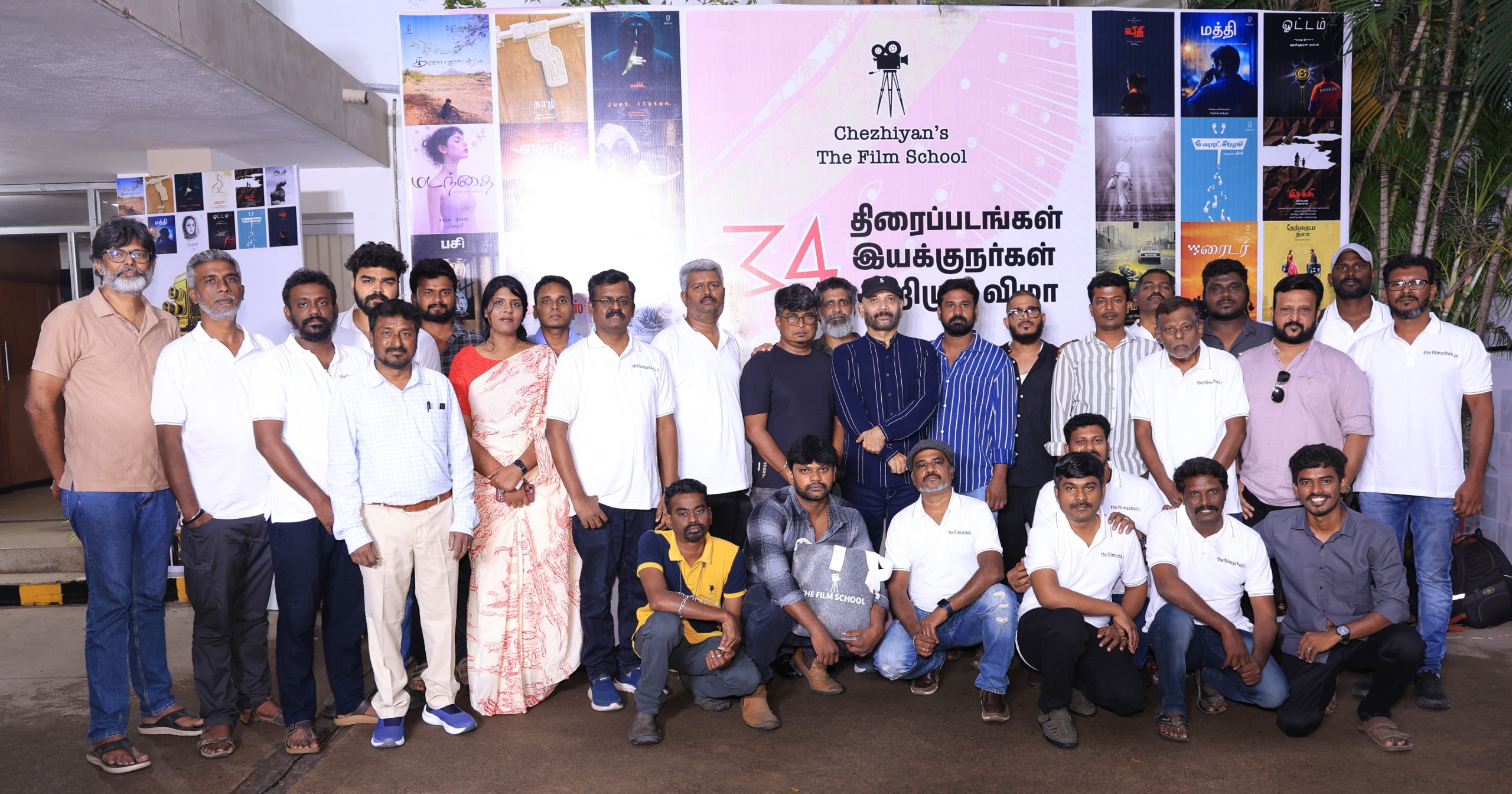
Chezhiyan, a multifaceted personality who has left his mark on Tamil cinema as a cinematographer, director, writer, and film enthusiast, runs a training workshop for future film industry creators called ‘The Film School’. 34 student filmmakers, honed at this workshop, are collectively creating 34 independent films. The launch ceremony for these films was held grandly in Chennai. It is noteworthy that for the first time in the history of world cinema, 34 films by 34 individuals who studied at the same institution have been launched simultaneously.
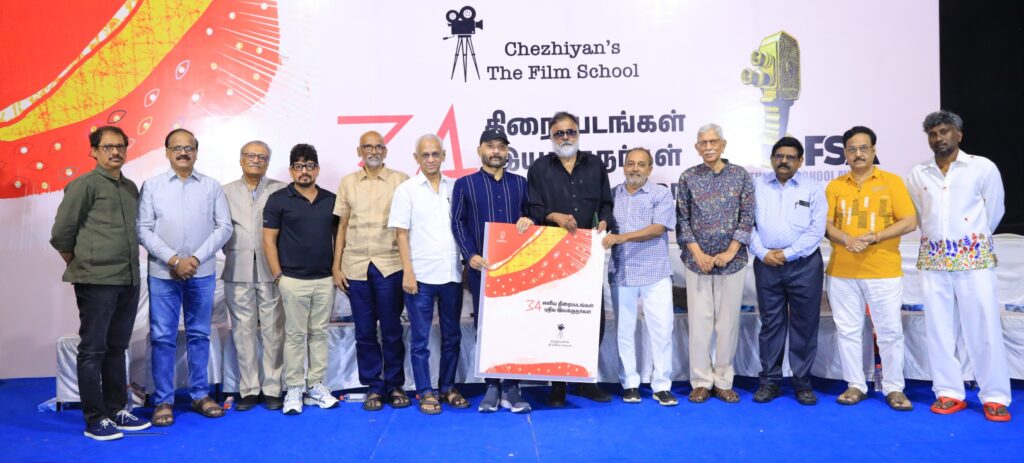
At this event, which created a new chapter in Tamil cinema history, ‘The Film School’ founder Chezhiyan was joined by editors B. Lenin and Sreekar Prasad; cinematographers P. C. Sreeram and Ravi Varman; graphic designer Trotsky Marudu; producer-critic Dhananjayan; directors Gnanarajasekaran and Hariharan; sound engineer Tapas Nayak; film critic Dr. Thayappan; and writers Pattukkottai Prabhakar and Tamil Prabha as special guests.
Welcoming everyone who attended the event, Mr. Chezhiyan said, “I welcome all the guests, friends, literary figures, and my students from The Film School who have graced this occasion. I also express my heartfelt gratitude to everyone.
Before writing my book on world cinema, I read about the German director Werner Herzog. He studied at a film school. After completing his studies, he stands in front of a glass cage…” Then he says, “Give me a camera from there, I’ll take a picture and return it.” It was a camera belonging to the institute. They said they couldn’t give it to him. That night, he broke the glass case, took a camera, took the picture, and then returned the camera. After that, I started searching for a lot of information about him. That’s when I confirmed the information that he had studied at the Rogue Film School. Rogue can be interpreted in many ways: nomad, rebel, wanderer, and so on.
After that, I researched the admission requirements for the school he attended. To join that school, one had to have read 12 books. Wherever you went, you had to travel on foot, not by vehicle. You had to possess sensitivity. You had to be able to tell a story to a four-year-old child for half an hour without their attention wavering. He says that if you can do all this, you can join their film school. They ask him for the film school’s address. He says, “I am the address.” He is a nomad. If he’s in New Zealand, a ten-day class will be held there. If he’s in Germany, a ten-day class will be held there.
After that, I met the Iranian director Makhmalbaf in Chennai. I spent three days with him. He was running a film school. I asked him about the syllabus and admission procedure for his film school. He said you have to read a book of poetry for a week. You have to choose one painter and continuously look at their paintings for a month. After that, you have to continuously read the short stories of a writer for a month. After that, you have to cycle 50 kilometers every day. You have to swim for an hour. I immediately asked if I could join his film school. He replied, “They exiled me saying I was making a film against the government. I am in Russia. I have now come to India from Russia. I am the one behind that film school,” he said. Then he added, “I am coming to India for a 15-day trip. Gather all your friends in one place. We will talk about cinema together for ten days. On the eleventh day, we will start the film’s work, and complete all the work in 15 days.”
This is the concept of my film school. I don’t intend to create it as something grand, a festival, or a large institution. This is an organization where friends who are passionate about serious cinema and friends who are deeply interested in literature come together and work.
If a massive apartment complex with 500 residences is built somewhere in Chennai… the government should create a park nearby. It should have a lawn. There should be trees. This is the rule. Similarly, cinema is a huge industry.
Just as there should be natural lawns and trees alongside artificial, massive buildings, that’s how the cinema of this film school should be.
Now we are always in air-conditioned environments. We should walk on the lawn for a while. Make films ranging from three crores to 300 crores. Let them all be successful.
Let it succeed. Let some films be made with an investment of 20 lakh rupees. If the big actors and producers here dedicate 10 or 12 days a year to support such an endeavor, a huge change will occur. Commercial cinema will succeed, and small-budget films will also succeed. Both will grow together. This industry must also grow. Cinema needs something organic.
“Keep sowing the seeds,” Nammazhvar would often say. So we are continuously sowing the seeds. What he planned to do in agriculture was organic farming. What we plan to do is also organic cinema farming,” he said.
World cinema researcher Dr. Thayappan said, “In the 1950s, a movement called the New Wave emerged in France. This movement arose to break away from the existing, stale traditions in writing, music, painting, politics, and film, and to spread new ideas. This impact was also felt in cinema. Critics who were tired of criticizing traditional films began discussing the New Wave. Breaking away from established traditions of familiar screenplays, conventional camera angles, and familiar lighting/sound design, they embraced unconventional camera angles, realistic stories, stories about young people, and natural lighting/sound design in their creations.
This New Wave also has a connection with politics. Realism emerged only after the fall of Mussolini.
The New Wave is not a movement, a philosophy, or a group. It is about equality. This word ‘equality’ itself emerged as a political mantra that sowed the seeds of the French Revolution.
When Dr. Ambedkar drafted the Indian Constitution, he created the concept of equality as an inherent and ethical principle.” The new wave is about creating works that allow the audience to see themselves within the creation, rather than merely viewing it as spectators.
Breaking with tradition and creating a new wave should have happened in the Tamil context a long time ago. Because Periyar, who sowed the seed of thinking outside the box, was here. The new wave films should have been an extension of his ideology. However, instead of having a significant impact, we continue to churn through the same old garbage. While a few attempts have been made before, they haven’t achieved complete success.
There is no work from the new wave perspective about the Kilvenmani massacre. There are so many incidents in Tamil Nadu. There is no in-depth work about Prabhakaran, who died in 2009, here yet. We are even using the anti-Hindi agitation merely as a set prop.
“Chezhiyan doesn’t like being praised, but Chezhiyan is Chezhiyan. We will see Chezhiyan as Chezhiyan,” he said.
Writer Tamil Prabha, speaking at the event, said, “I am speaking here as a student of Chezhiyan. He is the one who showed me a different perspective on world cinema. I believe that if filmmakers have a strong literary background, rich creations will emerge from them. He is knowledgeable in literature, painting, and music. I think he designs every scene as a blend of these elements. I see that when students graduate from his film school, a significant change – a movement – will continue in Tamil cinema.
Even though we categorize films as commercial cinema and art cinema, it seems to me that in Kerala, they are continuously nurturing art and literature-based cinema. But I think this is slowly disappearing in Tamil. I feel that a creation within a pure art form is not being created in Tamil. I believe that the students of Chezhiyan’s The Film School will fill this void,” he said. Director Gnana Rajasekaran, speaking at the event, said, “Today, a Tamil film is being released simultaneously in 2000 theaters. I think this is a wrong precedent. There is no one here to raise their voice against this. A major revolution needs to happen in Tamil cinema because of this. Cinema is not just about commercialism; it also involves creative talent.
Every filmmaker had the comfort of showcasing their work to the people and receiving either success or failure as a reward from them. This situation prevailed in Tamil cinema for a long time. That situation has suddenly changed today. Now, they have transformed it into an industry where only a few succeed and most face failure. Chezhiyan has started a small reform effort in this regard. My best wishes to him,” he said.
Writer Pattukkottai Prabhakar, in his speech, said, “Chezhiyan introduced world cinema through his writing. Reading his serialized articles always inspired me. Chezhiyan is the one who sowed the seed of ‘we too can do it’ in me. He started the film school precisely to share his knowledge of cinema with others…”
He said,
“Currently, many directors are in the mainstream thanks to the ‘Naalaya Iyakkunar’ (Tomorrow’s Director) program on television. I am confident that many of the 34 creators from Chezhiyan’s school, like these directors, will also leave their mark in the mainstream. I wish them success in their endeavors.
When Chezhiyan met the Deputy Chief Minister, he not only handed over the invitation but also included a request. I wish his effort success,” he said.
Speaking at the event, translator and writer V. Sriram said, “Due to technological advancements, everyone can now watch world cinema from the comfort of their homes. Such facilities were not available in the 1970s. Only those who were members of film-related organizations, and even then only a select few, had the opportunity to watch such world cinema. Because I worked at the French Consulate in Chennai, we screened a French film every week. Before the screening, we would provide a brief summary of the film. I expected a discussion about the film after it ended, but that didn’t happen. Especially in Tamil, there was no one to talk about it. Following that, through the Chennai Film Society, we published a book called ‘Cinema Beyond Tradition’. Director Hariharan had written an excellent foreword about this new wave in that book.
This is Chezhiyan’s effort, stemming from the thought that works related to the new wave shouldn’t only be published in Europe, but should also be published in Tamil. I wish his effort success,” he said.
Producer Dhananjayan said, “Chezhiyan is the one who created the film ‘To Let’ with a budget of 50 lakh rupees, screened it at all international film festivals, won awards, and created a film that remains a benchmark in Tamil cinema to this day. That’s why I like him very much. I have mentioned him with pride on many occasions.” I am very happy with this initiative he is taking. This is an event that should be held in the presence of many producers.
In this regard, I am also planning to organize a major event in Chennai with the support of the Central Government in the coming April, and I am working towards that. I see this event as a prelude to that.
The 34 directors being introduced here have said that they can make films for 30 lakhs. Even if 10 of them succeed, Chezhiyan’s effort will be a huge success,” he said.
Director Hariharan said, “After meeting the Iranian director Makhmalbaf, I introduced the things he taught about cinema to my students.
The 34 directors being introduced here should always work together. If you all go your separate ways, what you have learned will become useless. You should always share your thoughts with others. Only then will a revolution be born. A new wave will emerge,” he said.
Ravi Varman said, “I was introduced to Chezhiyan as a writer who wrote about world cinema. After reading Chezhiyan’s lectures, I have watched many films. Chezhiyan can never be confined to a single definition. He has brought the ambitions of many people within a few lakhs of rupees. That is a tremendous effort. For this, I wholeheartedly congratulate him. 34 films is not an ordinary thing, it is a rare event.
In China, mini-series of two or three minutes are currently being introduced. Currently, we are watching films that last two or three hours. Such films will not be made in the future. Songs are not included in the films that are being released now. They will be released as separate albums. After that, a separate music bank will be created for them.
May Chezhiyan, who has created immortal creators, live long,” he said.
Editor Sreekar Prasad said, “Honesty is very important for independent filmmakers.” “And create your works not for the present time, but for the future. My best wishes to all 34 directors,” he said.
Speaking at the event, Mr. Trotsky Marudhu said, “I have known Chezhiyan for over thirty-five years. He is a very meticulous technical artist. His clarity has evolved into a movement related to a new wave in the film industry. I think this is just the beginning. Such an effort has not been undertaken in the last 40 or 50 years. In this era of technological advancement, it has become possible to create a film as easily as one would create a painting or a poem.
This is a time for collaborating with fellow artists. I consider Chezhiyan’s initiative in this regard to be very important. I extend my congratulations to the students of The Film School who have made these 34 films possible, and to those who supported them,” he said.
Editor B. Lenin, speaking at the event, said, “Action films are alternative cinema. What we are creating is…”
Regional cinema. If you know the seven musical notes, you can go anywhere in the world and communicate. There is no need to know English. There is no need to know Hindi. Knowing Tamil alone is enough.
In the profiles of the student filmmakers from The Film School, which were given to the guests here, the maximum budget for a film is mentioned as only 50 lakhs. The number of shooting days is also mentioned.
We are currently compiling that information. When we look at it, the number of days is not clear. They have completed the shooting of the full-length feature film within the specified number of days and delivered it.
This is my 61st year working in the film industry. I am still continuing to work. The script is important. The screenplay is also important. So, all the young directors, be pleasant and presentable in the present. Congratulations,” he said.
At this event, cinematographer P. C. Sreeram released a commemorative booklet containing details of 34 independent films directed by young filmmakers – including the synopsis, budget, and shooting schedule of the films they are creating. Mr. Trotsky Marudu received it.
Following this, a competition for short films and documentaries was held by The Film School. Srikar Prasad, directors Gnana Rajasekaran, Hariharan, and Dhananjayan honored the winners by presenting them with awards.
Subsequently, all 34 films were screened. Film industry personalities viewed all of them and happily shared their best wishes with the young filmmakers. The names of the 34 filmmakers and details about their works are as follows:
- Amal – Terrorist
- Chandru – The Nest
- Vijay Subramanian – Just Listen
- Vini Leetus – Cycle
- Kumaravel – Yesterday’s Moon
- Sasikumar Thirumoorthy – Save the Cat
- Lenin Seetharaman – Mohana Mathil
- Anudeepan – The Last Frontier
- Bala Seetharaman – Hunger
- M. Karthik – Mayila
- Hariharan Rocky – The Run
- Pon Bhuvaneswaran – Mobile Phone
- Michael – Fruit
- Mahesh Murugesan – Meow
- Pinci – Maiden
- Veera – Fate
- Santhosh – Practice Dharma
- Balu Murugesan – The Abyss
- Senthu – Support
- Naveen Seetharaman – The Umbrella Giver
- Vetriselvan – The Herd
- Vignesh – Lagadu
- Kottai Raj – Isakki
- Senthil – Forest
- Ernesto – Embers
- Vinoth – Companion
- Adam – Kannayiram
- Yuthwin Subash – Middle
- Habib – War Kids
- Krishnamoorthy – Arugan
- Sekar – Rider
- Akhil Rahman – The Silent One
- Thilak – Meenakshipuram
- Mahesh Mishra – Silence
Further details about The Film School can be found by visiting the website https://thefilmschool.in/.