

47th Annual Function of the Sri Sivakumar Educational Trust! Rs. 1 Lakh Award for Artist Jeevanandhan; Rs. 13.78 Lakhs in Financial Aid for Students and Educational Organizations!
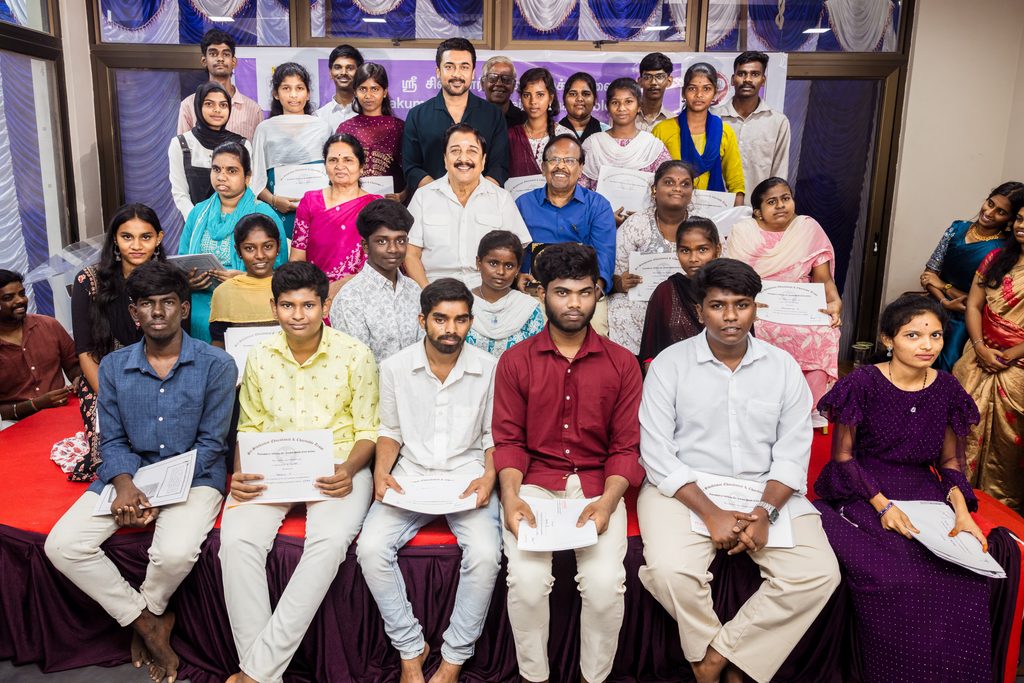
The 47th annual function of the Sri Sivakumar Educational Trust was held at the Agaram Foundation office in T. Nagar, Chennai. At the event, financial assistance was awarded to 25 students who had completed their Class 12 exams and enrolled in college; a senior artist received both a cash award and a citation; and three key organizations working selflessly for the educational upliftment of marginalized communities were provided with financial support.
The trust was established in 1979 with the aim of helping students using the interest earned from a bank investment of Rs. 25,000—the entire remuneration received by actor Mr. Sivakumar for his 100th film, Rosappu Ravikkaikari. While initially prizes were awarded to students, scholarships were later provided from Mr. Sivakumar’s personal funds. Since 2006, the ‘Agaram Foundation’ has fully assumed responsibility for the trust and has been presenting these scholarships and awards annually.
Award for Artist Jeevanandhan:
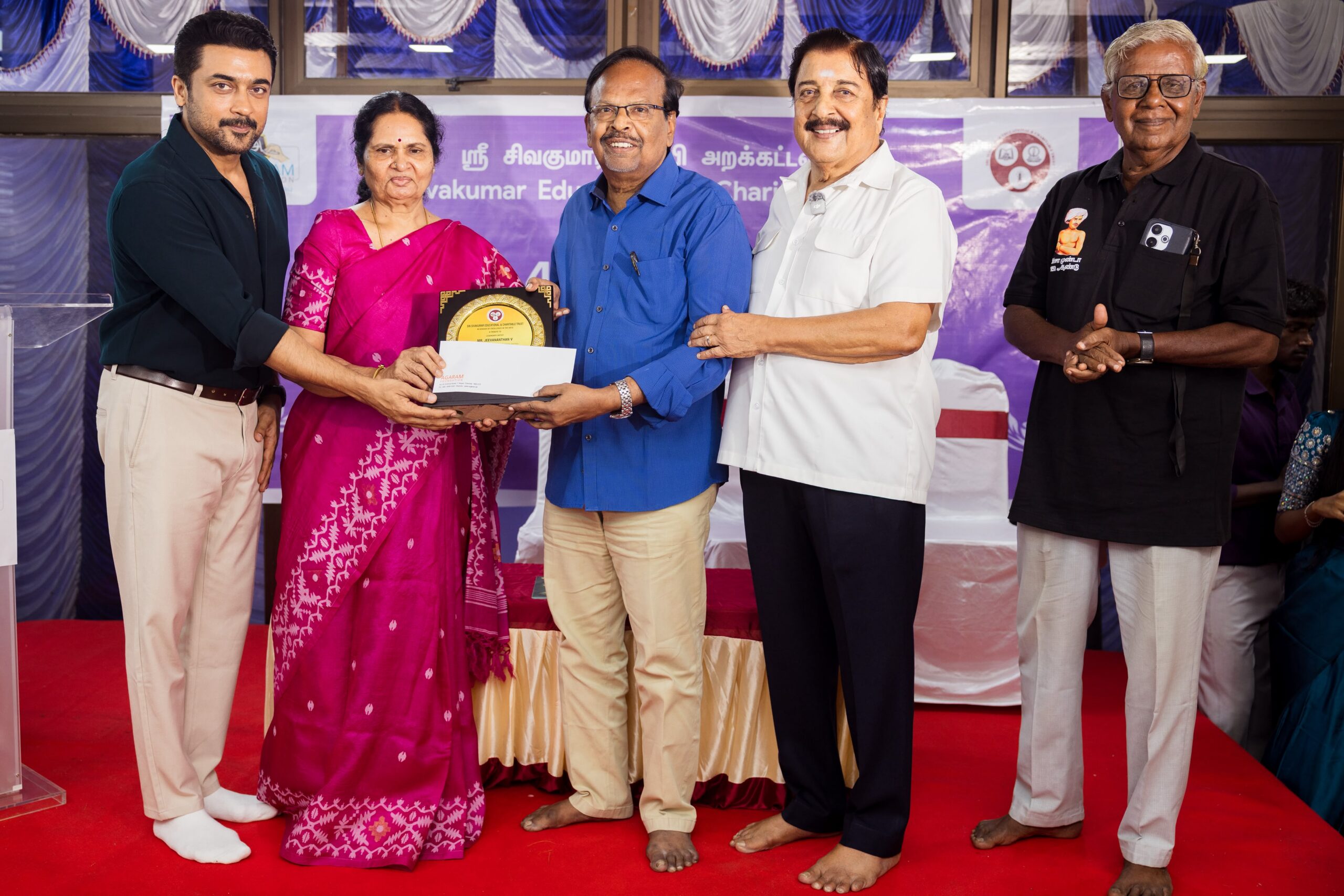
In addition to encouraging academically outstanding students, the Sri Sivakumar Educational Trust presents an annual award—accompanied by a cash prize of Rs. 1 lakh—to honor senior artists who have made significant, long-standing contributions to the field of art. While artists such as ‘Ambulimama’ Shankar, Ramu, Jayaraj, Maya, and Maniam Selvan have received this honor in the past, the 47th-anniversary event saw artist Jeevanandan—an accomplished artist and a significant figure in the field of art—honored with an award and a cash prize of ₹1 lakh.
Educational Incentives for 25 Students!
A total of ₹2,50,000 in educational incentives was distributed—₹10,000 to each of the 25 students—who had overcome economic challenges and various obstacles to secure high marks in the Class 12 public examinations and subsequently enroll in college. Certificates were also awarded to appreciate the students’ achievements and further encourage them.
Furthermore, financial assistance was provided by the Agaram Foundation to acknowledge the selfless service of the following three organizations working for the education of marginalized students:
1. Financial Assistance of ₹6,28,000 to ‘Thai Tamil School’, Tindivanam:
‘Thai Tamil Primary School’ has been operating for the past 25 years in the Rosanai area of Tindivanam, driven by the noble philosophy that “mother-tongue education is the best form of education.” The school provides free education as well as a midday meal scheme to its students. Agaram has been supporting the school’s commendable work for the past 16 years. Continuing this support, a letter of commitment was handed over to the school’s administrators, pledging ₹6,28,000 towards the monthly salary contributions for the teachers for the 2026–2027 academic year. 2. Financial assistance of Rs. 2,00,000/- to the Erode-based ‘Sudar’ organization:
‘Sudar’ is an organization that has been working for the past 20 years to improve the education of tribal children in the Erode district. They operate 25 after-school study centers in the Sathyamangalam and Bargur hill regions to bring school dropouts back to the classroom and to bridge learning gaps. A cheque for Rs. 2,00,000/- was handed over to Mr. Natarajan, the founder of ‘Sudar’, as a contribution towards the financial resources required for these noble initiatives.
- Financial assistance of Rs. 3,00,000/- to the ‘Vaazhai’ organization:
Founded by alumni of Presidency College, Chennai, the ‘Vaazhai’ organization has been providing mentorship to government school students in districts such as Dharmapuri and Villupuram. Currently, they are spearheading educational improvement initiatives by appointing teachers in seven government primary and middle schools located in the Aiyur forest area of Krishnagiri district. To support their voluntary efforts, a letter of commitment was handed over to the ‘Vaazhai’ volunteers, pledging a total contribution of Rs. 3,00,000/- for the year, disbursed at a rate of Rs. 25,000/- per month.
Speaking at the event and commending the students, film personality Sivakumar said:
“There is just one thing I would like to tell the students: if you possess education and discipline, you can achieve success in any corner of the world. That is the fundamental foundation.” Whether you were born to poor parents, lost your parents, or were born in a village—do not worry about any of that. Understand this: if you possess education and discipline, you can go anywhere in the world and achieve success. I am a small—a very small—example of that.
Back when I was studying, there were no proper schools, no school buildings, and no formal teachers. Everything was private—private schools and private tutors. A place called ‘Kalangal’ is located exactly four furlongs from my village; it is the birthplace of G.D. Naidu. In the center of that village stood an open hall—a structure measuring 30 by 60 feet. The floor of that hall was always covered in dust. On our way there from the village, we would often encounter cow dung along the path.
We used to gather the cow dung, put it in a basket, mix it thoroughly with water in a vessel, and smear the floor with it; otherwise, dust would fly around inside. After coating the floor, that is where I would sit and study. To keep onlookers away, we erected bamboo screens—three of them—to enclose the space.
Our teacher was Kalyanaswami Naidu. Back in the 1940s, he had secured second place in the state in Mathematics—he was a prominent figure in the subject at the time. He ran a private school. The monthly fees were one rupee for the first grade, two rupees for the second, three for the third, and four for the fourth. I was in the second grade, and my elder sister was in the third. In those days, a sovereign of gold cost twelve rupees. So, with my sister’s fee at three rupees and mine at two, the total came to five rupees—almost the price of half a sovereign. My father passed away when I was just a ten-month-old infant. Throughout my life, I saw my mother wearing only a white sari. My father had left behind a parched, dry stretch of farmland after toiling over it; my mother worked hard on that very land to fund our education. Because we couldn’t afford the five-rupee monthly expense, my sister’s schooling was stopped after the third grade. I am well aware of the hardships students from poor rural families face in their pursuit of education. I have also personally experienced how education can elevate a person’s standard of living. It gives me immense satisfaction to assist students who, like me, come from impoverished backgrounds and aspire to succeed through education. Every victory they achieve by overcoming obstacles marks a new beginning in their lives. This is merely the first success in your journey; the road ahead is long. Students must remain steadfast in their goals, maintain discipline, work hard without losing focus, and progress in life. They should fully utilize the opportunities provided by education to bring pride to themselves, their families, and society.
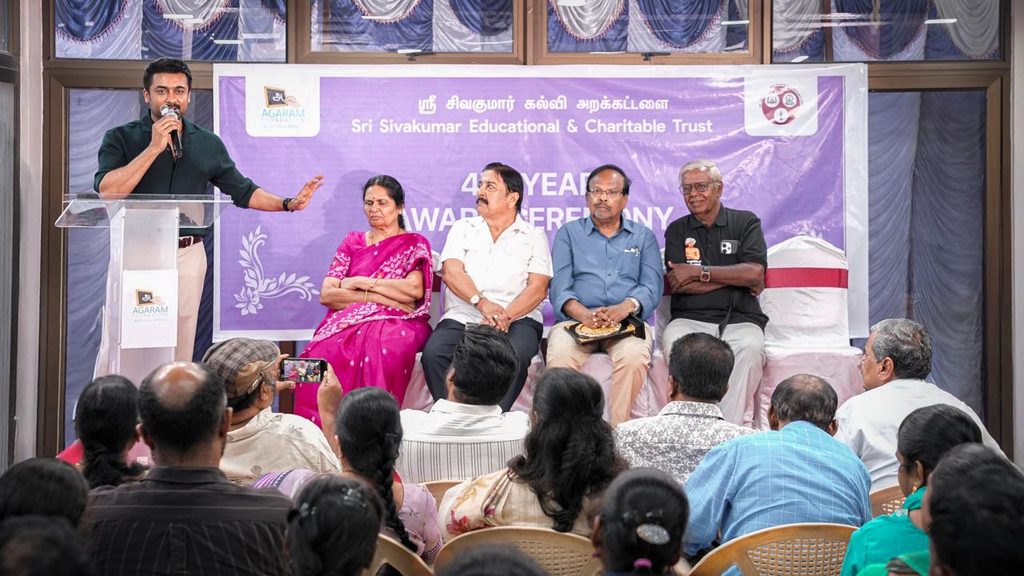
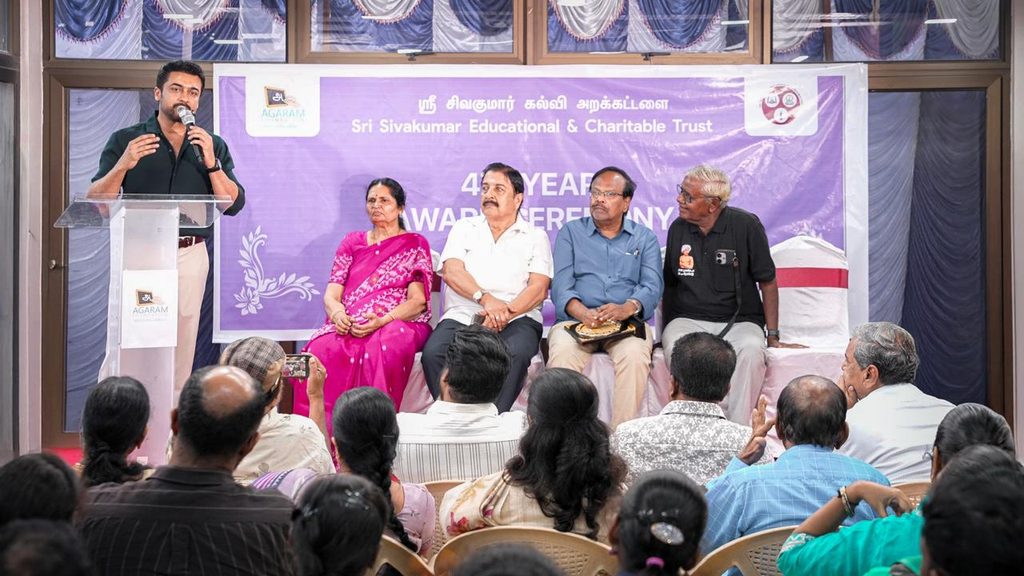
Speaking at the event, actor Suriya said, “This is a family gathering. Just as a 47th birthday is celebrated at home, we view this event—every single time—strictly as a family occasion. With each passing event, this family continues to grow larger. When the students present here share their achievements and receive their awards, I am filled with awe at the many challenges and hurdles they have overcome. It is my father’s guidance that has enabled us to carry this initiative forward for so many years. It is an emotional bond; this is simply how we were raised.” This is how they have brought everything right here and placed it before our eyes.
It has been over 20 years since Agaram began. We have managed to reach approximately 7,000 people—including the families of our first generation of students. Agaram continues to drive many initiatives, and the mission we originally set out with remains undiminished. The reason it continues to function so effectively is largely due to key figures like Mr. Kalyani standing with us and lending their support. Questions regarding social perspective—asking “for whom are we doing this?” and “for what purpose?”—were constantly raised by them. Whether it was the mentors, the students, or the alumni who are now taking Agaram forward, it was mentors like him who ensured everyone maintained the right perspective. Consequently, rather than limiting ourselves to our initial scope, we began to look for others in need—children who required support and those we needed to reach out to and guide. We discovered significant issues regarding school dropouts, particularly within the Muslim community and among female students. We were able to undertake initiatives there, as well as in hill villages and coastal areas. When it comes to such needs, there is still an immense amount of work to be done. Gnanavel, who started out as a student journalist in 2006, asked this one crucial question: “First-generation learners still exist. A girl from a remote hill village and a girl from a fishing hamlet both sit for the same 12th-standard exam. In many of those areas, there aren’t even any teachers. Yet, everyone takes the exact same test. Do you see them? Do you realize they exist? Do you know that there are first-generation learners among them?” You might ask, “Well, my father left for Madras back in the ’50s or ’60s; what you’re describing happened 50 years ago—where are the first-generation learners now?”
We used to speak casually, asking, “Are there students?” Back in 2006, the reply was, “No, brother, there are first-generation students.” Now it is 2026, and first-generation students are still coming in, studying, and graduating. It brings me immense joy to think about how Agaram seeks them out, brings them forward—reaching out to those in need even before they ask—and shows them the world and the light of opportunity. I want to express my gratitude to everyone involved in this effort.
They say it has been nearly 28 or 29 years since I entered the film industry. I want to share something I learned from cinema with you. In filmmaking, we have “retakes.” A scene isn’t always completed in a single shot; sometimes it takes five or six takes. To ensure the shot turns out perfectly, we might go for as many as 18 or even 30 retakes. Yet, every time something goes wrong, the director doesn’t say, “You have failed.” Instead, he says, “One more.” I view life the way I view a director. Life never labels you a failure. You might think so, but that isn’t the reality of life. Always tell life, “I am going to do it again—one more time.” Tell yourself, “I can do it again.” It could be your exam marks, a college admission, or your first job. If you aren’t satisfied with the outcome, it isn’t the end of the road; it isn’t the final verdict. The only thing you need to say is, “One more.” You can set it right, take another chance, and improve upon it. So, always remember that there is always “one more” opportunity. Please never forget that nothing is ever truly the final end.
Then there are rehearsals. You might watch a two-and-a-half-hour movie, but we would have rehearsed the material countless times without receiving any applause. We go through repeated rehearsals—moments that never get an ovation. Yet, I would say that is exactly what shapes you; those rehearsals are incredibly important. If you fully surrender yourself—heart and soul—to what you love, you can achieve the seemingly impossible. You don’t need to start out with a specific skill or artistic talent right away. It comes down to consistency. By doing something over and over again, you can improve and eventually excel at it. Whether it is coding, drawing, running, or anything else—the principle remains the same. I would say that consistency—repeatedly rehearsing—is where we truly take shape. Everything has a starting point. When I first entered the film industry, I didn’t know how to act; I knew nothing. It was the repeated rehearsals that have kept me standing here after 29 years. If I could make it, then you too can succeed in whatever you aspire to do.
Then there are the ‘credits’—after a movie ends, the names of everyone who worked on it appear on screen. A ‘hero’ doesn’t just walk out onto the scene all by themselves. There are so many people involved: assistant directors, writers, costume designers, makeup artists, drivers, helpers, and lighting crew. It is through the collective effort of all these people that one person is able to step into the spotlight.
When we rise in life, we shouldn’t just focus on things like ‘Reels’; we must not forget the people who stood by us—on our left and right—helping us get here and giving us this identity. Please, remember them. Likewise, once we reach a certain position, we should help lift someone else up. Our name should appear in their list of credits.
If you look at Instagram—specifically ‘Reels’—remember that a Reel is, in essence, a story. You won’t really learn anything from that. Who you choose to follow matters a great deal. If you keep living in a dream world, that is exactly where you will remain. Where did Elon Musk start? It is said that he used to work 23 hours a day, sleeping for only one hour. How did they begin? Instead of just watching short video clips (Reels), if you explore podcasts and research material about them, it will be incredibly helpful. It will assist you in bringing out the talent within you.
One thing I learned from cinema is the concept of the ‘retake’—don’t hesitate to ask for ‘one more take.’
Do your rehearsals, and when it comes to ‘credits’—let us not forget the people for whom and the reasons why we came here, or what brought us this far. So, always ask for ‘one more’ take, and let us strive to lift at least one other person up. Believe me, life is truly beautiful. We can become exactly what we envision. Thank you very much, and best wishes to everyone.
Special guests, artists, students, Agaram Foundation volunteers, and social activists were among those who participated in this event.