
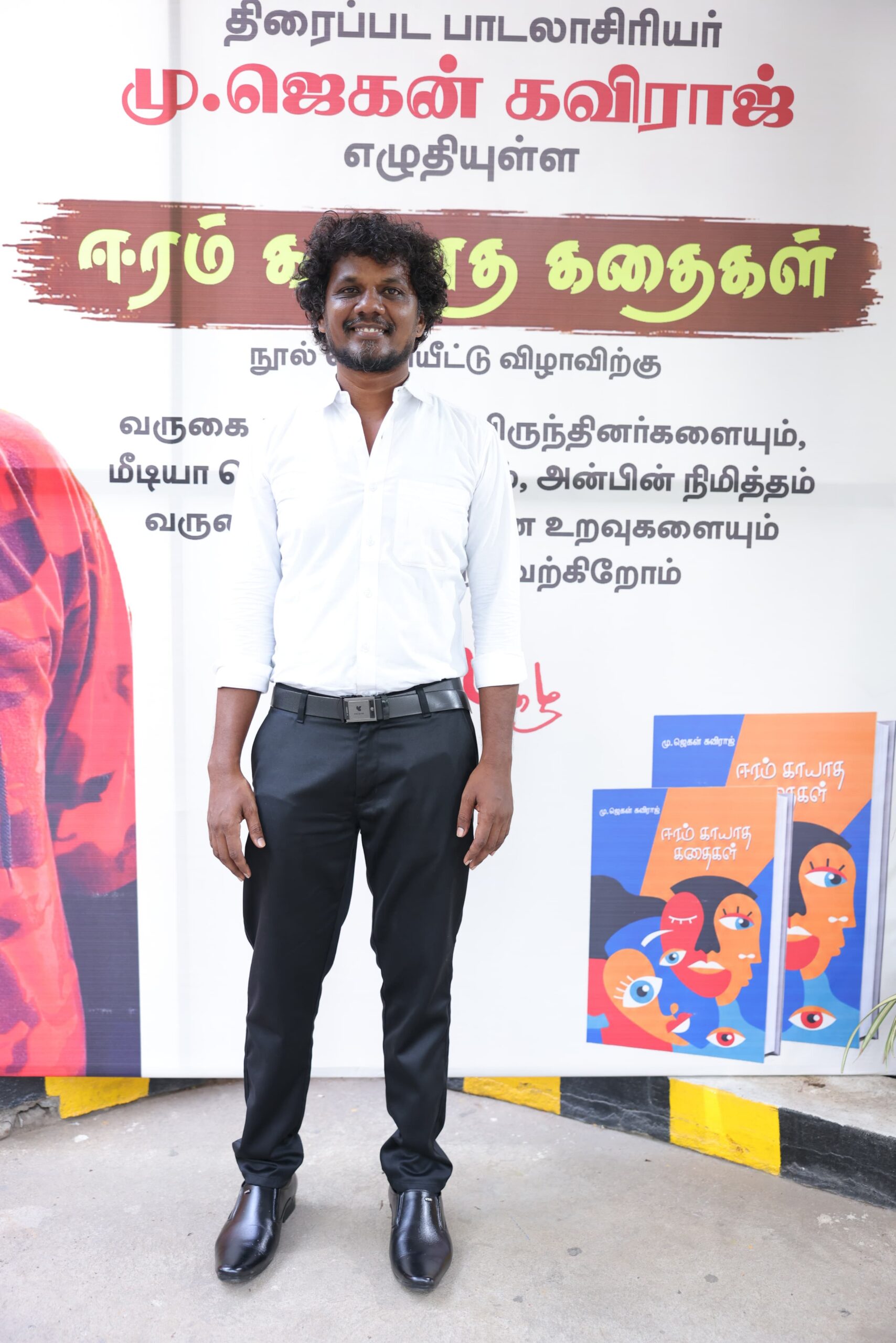
Book Launch Ceremony for “Eeram Kaayaatha Kathaigal” (Stories That Never Dry), Authored by Lyricist and Actor Jegan Kaviraj
“Why Did I Attend the Launch of ‘Eeram Kaayaatha Kathaigal’?” — Director Ameer Explains
“Everyone Must Read the Book ‘Eeram Kaayaatha Kathaigal'” — Kavithabharathi
Nivas K. Prasanna Shares Touching Reflections on the “Father and Diwali” Story
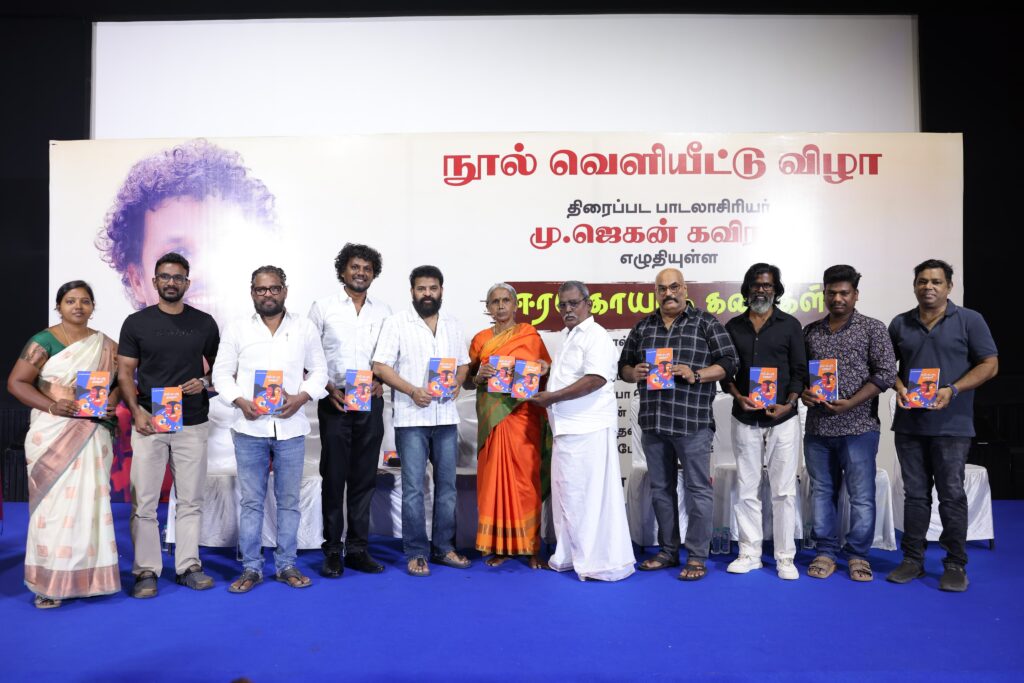
The launch ceremony for Eeram Kaayaatha Kathaigal (Stories That Never Dry)—a collection of short stories written by lyricist and actor M. Jegan Kaviraj—was held in Chennai. Director and actor Ameer released the book, while Jegan Kaviraj’s parents, Mr. Muthiah and Mrs. Lalitha, received the first copies.
Speaking at the event, Village Administrative Officer Annalakshmi remarked, “Jegan Anna (brother) and I hail from the same hometown. He possesses many admirable qualities; chief among them is his reading habit. He is someone who reads with a specific plan—setting a daily target for the number of pages he intends to cover. In various interviews, he has often expressed regret over not having completed his formal schooling. However, he has ‘read’ the lives of human beings. The stories featured in this collection are crafted from oral narratives—tales recounted by the grandfathers and grandmothers of our village. It was only after reading Jegan Anna’s stories that I began to view the people of our village from a fresh perspective. Many more stories lie hidden within him; I hope to see them emerge in his future books. For that to happen, may both Time and the Muse of Storytelling bless him.”
Senthilkumar IRS, a native of the author’s hometown, spoke next: “The book Eeram Kaayaatha Kathaigal serves as a vivid expression of our village and the remarkable lives of the people who inhabited its surroundings. I was truly astonished to find that Jegan has naturally imbibed the writing style of literary greats—such as Ki. Ra. (Ki. Rajanarayanan) and Thoopil Mohamed Meeran—who possessed the rare ability to absorb and portray the essence of village life with such depth. Our friendship, in fact, began even before we truly knew who the other person was.” Since both our fathers were classmates, our friendship began in early childhood; however, as our paths diverged in various directions, we had already crossed our thirties by the time we reconnected. In the world of writing, failure often outweighs success; it can inflict profound emotional anguish and impose heavy financial burdens. When Jegan chose to enter this field, I anticipated that it would present an immense challenge. Yet, within just a few years, he achieved remarkable success—and not merely in a single domain, but across multiple dimensions. Whether it be songwriting, acting, or authoring books, his accomplishments have brought immense pride to our entire hometown.
Typically, individuals emerging from such backgrounds tend to harbor anger toward society. This often manifests in the sentiment that “all rich people are evil” or “all politicians are corrupt.” They frequently attempt to carve out a distinct identity for themselves—whether based on religion, caste, race, or language—and subsequently seek to write or live their lives while sheltering behind that specific identity. However, the hardships Jegan endured have instead transformed him into a truly evolved human being.
The manner in which he approaches and observes any subject—viewing it from the perspective of an “insider”—is truly astonishing. I came to understand the true essence of who he is far more through his stories than through our personal interactions. In the field of social studies, scholars distinguish between the “Etic view” and the “Emic view.” The Etic view involves observing a society from a detached distance—a perspective that comes naturally to almost every writer. However, Jegan possesses a rare gift: the ability to fully immerse himself within that society—to become it—and to write about its inherent nature and nuances with exceptional brilliance. This extraordinary ability is vividly evident in this book.
This book possesses the same depth and profound resonance found in Iranian cinema. “Every single story reminded me of Ki. Ra. and Thoppil Mohamed Meeran. This is because anyone who has read Thoppil Mohamed Meeran’s works knows that, unlike the tendency to view the Muslim community from an extreme, external perspective, he wrote about it naturally—from the inside. Jegan, too, has written about our people very naturally, without merely glorifying them. I wish my friend continued success in writing many more stories like these and achieving even greater heights,” he said.
Speaking on the occasion, Kavitha Bharathi remarked, “During my youth, I published a book of poetry. Out of 1,200 copies, we distributed 1,000 copies free of charge. I sent the remaining 200 copies to various magazines for review; however, not a single review appeared in any of them. Of those thousand copies, I distributed two hundred myself, while my father likely distributed the remaining eight hundred. Every day, my father would pack ten books into a bag, load them onto his bicycle, and wherever he went—to meet friends or acquaintances—he would proudly declare, ‘My son has written a book!’ and hand them a copy. The poignant detail here is that my father did not know how to read. For a father who could not read, the fact that his son had written a book was a matter of immense pride. I believe that on this very stage, there can be no greater honor than the moment the author’s parents were invited up to receive a copy of the book.
Speaking in one’s regional dialect is often treated as a subject of ridicule. Every mother possesses a unique culinary touch. Fundamentally, Rasam is nothing more than a broth made by dissolving tamarind and tomatoes; yet, every mother’s Rasam possesses a distinct, inimitable flavor. However, my friends, the tragedy is that commercial brands like ‘Aachi Masala’ and ‘Sakti Masala’ have effectively obliterated those unique flavors of our mothers.”
[01/06, 22:24] Flowing Fizz: “The disappearance of regional dialects constitutes a language’s greatest loss. Today, if you speak or write in pure Tamil, you are labeled a ‘Boomer.’ Tamil, it seems, must now be written using English script; ‘A m m a’ is the linguistic currency of the current ‘Gen Z’ generation. In such a prevailing climate, the fact that my younger brother has chosen to write stories in his own regional dialect is a truly delightful and welcome endeavor.
This short story collection is structured much like a novel; all nine stories within it are interconnected, with every character sharing some form of mutual link or continuity. I can personally vouch for the excellence of these stories. People often assume that a writer must possess profound wisdom, encyclopedic knowledge, or specific intellectual expertise. I, however, believe that a writer requires none of those things. What a writer truly needs is a social conscience, a sense of responsibility, integrity, and a commitment to truth. The technical ‘craft’—the mechanics of writing—are merely secondary considerations. The fundamental basis for appreciating a writer lies in why they write and what message they convey through their work. In that regard, Jegan has used this collection to document the observations, moral lessons, and instances of both justice and injustice that he has witnessed. This book contains ample evidence to suggest that Jegan has the potential to become an excellent film director. I highly recommend that everyone purchase and read this book,” he said.
Director Subramaniya Siva remarked, “How truly wonderful was the story about the ‘Father’ that Kavitha Bharathi just shared! It immediately brought memories of my own mother flooding back. My mother is illiterate; she does not know how to read or write. Yet, she always carries a small pouch for betel leaves and nuts—and tucked inside it, she invariably keeps a pencil. She is currently eighty-six years old; for as long as I can remember—spanning perhaps twenty or thirty years—she has carried that pencil with her. Whenever she refreshes her supply of betel leaves, she carefully removes the pencil, ensures it is safe, and places it back into the pouch. One day, I asked her, ‘Mother, why do you carry that pencil around?'” “Oh dear, surely someone will eventually ask to borrow it for writing!”—that was her reply. “But Mom,” I asked, “has anyone actually asked to use it yet?” “Not so far, dear,” she admitted. That is the story of that pencil. What intrigues me—and remains my lingering question to this day—is simply this: Who is that person who will eventually come along and ask to use that pencil? I still cannot quite fathom the significance behind it.
Prior to this, he published a book titled Ezhuthappadatha Mugangal (Unwritten Faces). Now comes Eeram Kaayaatha Kathaigal (Stories Where the Moisture Has Not Yet Dried). Whenever I pick up a book, I make it a point to first read the dedication, the author’s note, and any forewords or commendations. In his author’s note, while writing about Sumathi Mayini—who stayed by his mother’s side and cared for her—he remarks, “Upon every single grain of rice my mother ate, Sumathi Mayini’s name is inscribed.” If you wish to identify truly exceptional people, you will find them among those who stand by you and care for you during times of illness; they are the ones who prove to be your most vital friends. Furthermore, Jegan Kaviraj describes his wife and children not merely as the “hands” that enable him to write, but as the “divine boon” that inspires him to do so. Within the confines of a single foreword, Jegan’s profound humanity and deep sense of gratitude shine through.
I hesitate to classify this book strictly as a collection of short stories. Rather, it is an anthology of the people Jegan has encountered in his life. I hold in higher esteem—and regard as the world’s finest writer—the one who chronicles the stories inherent in the people he meets, rather than the one who merely crafts fictional short stories. A “story,” in the conventional sense, is a product of the imagination. However, the lived experiences residing within another human being are unique; once that person passes away, those experiences vanish along with them. I feel a compelling need to absorb—or to document—the stories held within my own parents, who themselves never learned to read or write. Thus, anyone who absorbs the stories and experiences of ordinary people—and transforms them into a creative work—is, in my view, an invaluable asset to our society. “Such a book is Jegan Kaviraj’s Eeram Kaayaatha Kathaigal (Stories Where the Moisture Has Not Dried). In this work, Jegan Kaviraj has refrained from any exaggeration, narrating the stories with great simplicity using the local dialect. Jegan should write many more books like this,” he said.
Speaking on the occasion, Nivas K. Prasanna remarked, “My hometown is Tirunelveli. My acquaintance with Jegan Kaviraj began when I composed the music for the film My Dear Sister; he was acting in that movie at the time. The film’s director, Prabhu Jayaram, mentioned to me, ‘There is a man named Jegan; he writes very well.’ As music directors, we typically seek a ‘comfort zone’ with a lyricist we are accustomed to working with. Consequently, there is usually a slight hesitation when suddenly switching to someone new. So, I hesitated a little. ‘No, just give him a try,’ Prabhu Jayaram insisted. ‘Is that so?’ I replied, and right over the phone, I gave Jegan a specific meter to work with. Within the next ten minutes, he had written and delivered the complete song. That is how our acquaintance began. Subsequently, we started talking frequently—often discussing spirituality. He possesses a wonderful sense of humor. I soon realized that Jegan possesses an innate sense of rhythm. Every creative artist has a unique rhythm of their own. As composers, we require a certain silence; as writers, they begin with a blank sheet of paper. Yet, the creative source remains the same for all creators. That shared rhythm is what connected us. We continued writing songs together, and each one turned out beautifully. Our collaborative journey has now reached the film Thaai Kizhavi. Currently, he is writing lyrics for our next project, the film Makkal Kavalan. I am confident that our journey together will continue to be a very successful one.”
“He always radiates a positive energy.” It is that energy that transforms into art.
…I believe so. In this collection, I read the story titled ‘Appa Deepavali’ (Father’s Deepavali). I have a deep fondness for stories about simple people. Interacting with simple-hearted individuals is incredibly refreshing for the mind. Jegan Kaviraj is precisely that kind of person. Whenever I speak with him, he remains open to new ideas and perspectives. Jegan is destined to grow to even greater heights. My best wishes to him,” he said.
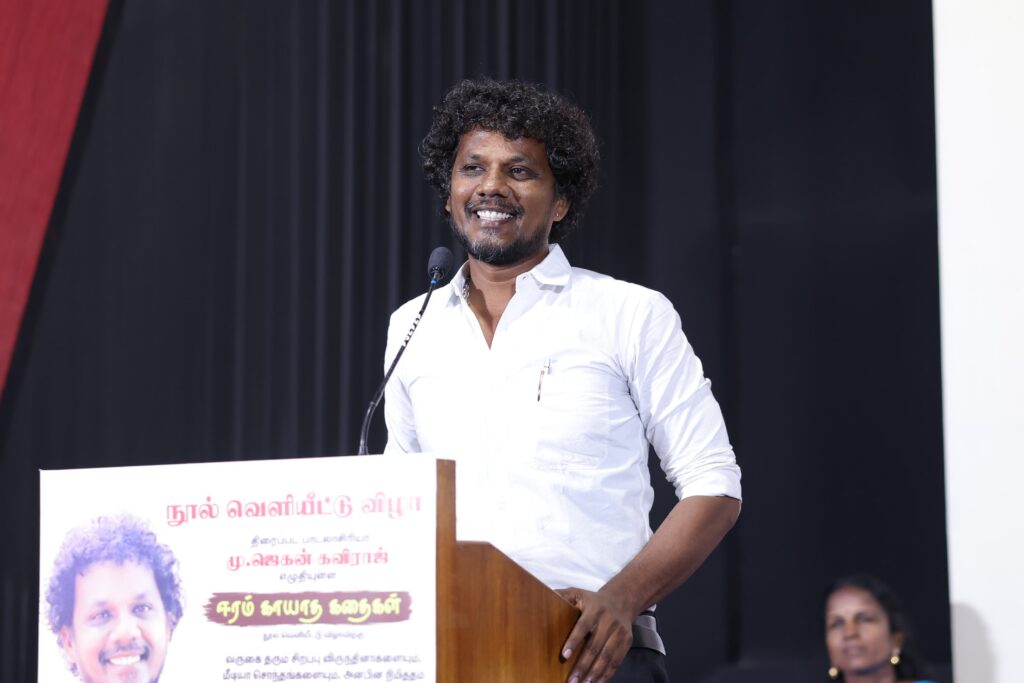
Delivering his acceptance speech, M. Jegan Kaviraj said, “During a deeply sorrowful period in 2014, I spoke with the late Devadas Ayya—who has since passed away—expressing my anguish that it seemed as though there would be no one left to celebrate me, to speak of me, or to appreciate me. At that time, he offered me solace by quoting a verse from Akila Thirattu (the scripture of Ayya Vaikundar): ‘The vision you seek shall appear right before your eyes, my son; do not despair!’ He assured me, ‘Whatever scenes you have envisioned in your imagination—Ayya will bring every single one of them into reality.’ My heartfelt thanks go to everyone who helped make this scene a reality today.
As everyone spoke about me, they remarked, ‘He is a good boy; he always speaks with a positive outlook.’ In most households, people attribute a child’s upbringing to the mother; however, we—my siblings and I—owe our upbringing entirely to our elder sister. Whenever we teased another child by asking, ‘Why is this child so dark-skinned?’, our sister would gently correct us: ‘Hey! I am dark-skinned too, aren’t I? If someone were to make a comment about that, they would be speaking about me. So, whenever you are tempted to speak ill of another child, you must think of me.’ She would instill this lesson in us every morning as we set off for school: that whenever we were about to speak negatively about any child, we must first think of her. Consequently, whenever we find ourselves in a situation where we might err or speak wrongly, we instinctively think of our sister. We are molded by our mother, but raised by our sister.” It gives me great joy that this sister is serving as the moderator for my book launch ceremony today.
A man once asked the Prophet Muhammad, “What should I do if someone in dire distress comes to me?” The Prophet replied, “Give him money.” The man asked, “What if I have no money?” The Prophet said, “Give him food.” The man asked again, “What if I have no food?” The Prophet replied, “Give him water.” When asked, “What if I have no water either?” the Prophet said, “At the very least, offer him a few kind words.” The Prophet teaches us that, in this world, even a few kind words constitute an act of charity. This lesson has been etched into my mind as indelibly as a nail driven into fresh wood. Ayya Vaikundar, too, advises us: “Speak only words of truth and righteousness, my son.” He essentially says, “Speak only excellent words. What is the worst that could possibly happen in life? What is to be gained by speaking negatively? Just speak a few kind words.” Perhaps it is because so many good people—following in Ayya’s footsteps—have taught me this lesson, but I find that I simply cannot bring myself to create negative characters in my stories. It is indeed true that if you think good thoughts, good things will surely happen.
I have acted in a film directed by Amir Sir, and I also penned a song for him in that movie. One particular line in that song goes: “I have never embellished the truth with lies; I have never stood with my hands tied in submission.” That line describes Amir Sir with one hundred percent accuracy. He is a truly exceptional human being—someone who simply does not know how to conceal what is in his heart; whatever he feels within, he speaks aloud without hesitation. At this juncture, I would like to place a specific incident on record.
Regarding our current Chief Minister—the Honorable Joseph Vijay—at a time when there was considerable speculation and uncertainty as to whether he would ever reach the towering heights he occupies today, Amir Sir made a singular statement in a magazine. He declared: “After the revolutionary leader MGR, a sharp new sword has arrived in Tamil Nadu.” “No one knows whether it will do any good or what exactly it is going to achieve,” he remarked. Everyone criticized Amir Sir for saying this. “What is the matter? Why is your guy talking like this?” they asked me. “Well, look—he has said it,” I replied. And what he predicted turned out to be true.
Amir Sir possesses the unique ability to foresee the growth trajectory of both an artist and a political leader. If he predicts something, it is bound to happen without fail. He has predicted that Nivas K. Prasanna will become a major star. I firmly believe that this will come to pass. My personal hope is that, even if Nivas K. Prasanna eventually takes up acting, he will still offer me the opportunity to write lyrics for his films. My family is well aware of the transformative changes that have taken place in my life since I met Nivas K. Prasanna Sir. He bestowed upon me a tremendous blessing. Before the release of the song Thaaykkizhavi, I would earn merely ten or fifteen thousand rupees per song; but in the aftermath, people began asking, “How much do you charge per song?” How many years I had to wait just to hear those words! The sole reason for this turnaround is Nivas Sir. My heartfelt gratitude goes out to him. My love and thanks to everyone,” he concluded.
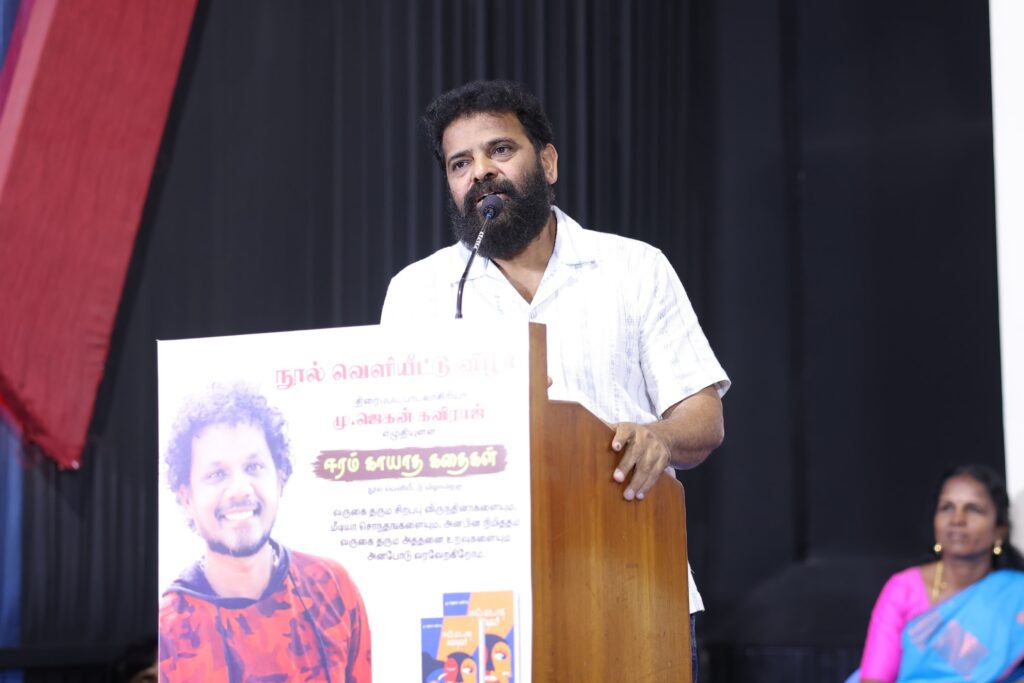
Finally, speaking at the event, Director and Actor Amir said, “I am essentially another version of the young boy featured in the film Taare Zameen Par. The mere sight of a book used to trigger a sense of anxiety in me. My reason for appearing on this stage today is not the book itself, but rather the person who authored it. The reason I have come here specifically for him is this: when a person has the privilege—with his own sister serving as the host—of having both his parents accept a copy of the book he has written, that marks the definitive moment when one can truly say that a man has achieved success in his life.” You know that moment—that specific juncture where one can declare that society has accepted them? That precise moment where one can demonstrate this reality to their own family? It is my custom to attend any such celebratory event, regardless of who is hosting it. The reason is simply this: I never had a ceremony of this kind held for me. I entered the film industry…
It has been five years. Not a single one of my films has ever had a success celebration. My family members have never attended the audio launch ceremonies for my films. That is precisely why, whenever I see someone standing tall—having made a name for themselves through their own efforts—and surrounded by their loved ones, I feel it is my duty to stand right there beside them. What greater success could a human being possibly achieve than this? If Jagan Kaviraj’s parents have traveled all the way to Chennai to witness their son on a stage like this for the very first time, then this is the true pinnacle of human achievement.
In a village called Poolankulam near Tirunelveli—where his parents made a living running a tea shop and engaging in agriculture—Jagan dropped out of school after the sixth grade and began rolling beedis. Concerned that he might go astray if left unchecked at the age of sixteen, his relatives collectively decided to send him away to Kanchipuram. In Kanchipuram, he worked in the scrap-dealing trade, and later traveled to Kerala, where he took up work as a manual laborer, carrying loads of soil. He then moved to Trichy, where he went from street to street, selling household vessels. It was the reading habit he cultivated by devouring books salvaged from old bookstores—the kind sold by weight—that ultimately brought him to this very stage today. Subsequently, he found his path within the ‘Ayya Vazhi’ tradition—a movement characterized by progressive thought and a Leftist ideology, centered on the worship of the One True God. He arrived in Chennai, worked at Vetrimaaran’s office, joined the production team of their film Nagesh Thiraiyarangam as a junior-most assistant, and later served as a cashier within the same company. From there, he began writing lyrics, ventured into the media landscape, penned the popular song “Jeeraga Biriyani,” wrote lyrics for the film Thaai Kizhavi, and has now written the lyrics for the very film I am currently starring in—all while writing a book of his own and hosting a grand launch ceremony for it right here in Chennai. I firmly believe that I have a responsibility to introduce individuals like him to society at large. “My wishes and gratitude go to Jegan for bringing his thoughts, ideas, the people he met, and the stories of his region to life in the form of a book,” he said.